


Free Range Organic Poultry Farming

APRC Course Details
shape
shape
  • Overview
  • Syllabus
  • Instructor

Why Select Our Free Range Organic Poultry Farming Training?

The Free Range Organic chicken Farming Training offered by the APRCINDIA is a comprehensive, end-to-end program designed to assist beginners and entrepreneurs in becoming skilled organic chicken farmers.

  • Expert Guidance: Training is led by industry professionals with years of experience in agronomy, soil science, and farm management.
  • Flexibility: The online format allows you to learn at your own pace and schedule, making it suitable for those with full-time jobs or busy family lives.
  • Modern Techniques: The course focuses on optimizing production processes using new technologies and sustainable practices.
  • Industry Standards: Experts provide support to help you meet current industry standards and evolving consumer expectations for organic products.

Who This Course Is For

  • Aspiring Farmers: Individuals looking to start a new, sustainable business in poultry farming.
  • Existing Farmers: Traditional poultry farmers who want to transition to organic and free-range methods for better market appeal and health outcomes.
  • Career Seekers: Those interested in specialized roles within the rapidly growing Indian poultry industry.

What you'll learn

  • The training covers the core pillars of free-range organic production:
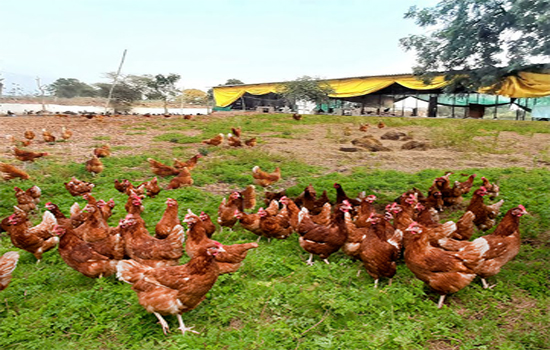
  • Housing & Environment: Designing layouts that allow for natural behaviors like scratching and foraging with access to fresh air and sunlight.
  • Nutrition & Feed: Formulating organic diets without synthetic fertilizers, antibiotics, or growth hormones.
  • Natural Health Care: Using herbal remedies and preventive hygiene to maintain flock immunity.
  • Farm Management: Record-keeping for certification and implementing robust biosecurity protocols.

Career Scope and Opportunities

  • Graduates can pursue various roles in India's fast-growing poultry sector.
  • Poultry Farm Owner/Entrepreneur: Starting your own farm for organic meat or egg production.
  • Farm Manager/Supervisor: Overseeing day-to-day operations and production goals.
  • Health and Nutrition Specialist: Advising on organic feeding programs and natural disease management.
  • Consultant: Providing expert advice on sustainable production and market expansion.
  • Marketing Manager: Promoting organic poultry products and managing distribution channels.
  • Module I - The Rise of Organic Egg Poultry Farming
    Structure of the Module
    2 Days
    1 hour/day
    Principles of Organic Production, What is Organic Egg Poultry Farming?
    Concept & Definitions: History of organic farming in India (Vedas, Vrikshayurveda) and global standards (FAO/WHO Codex Alimentarius).
    The Four Principles: Health, Ecology, Fairness, and Care.
    Conversion Process: Technical and ideological shifts required to move from conventional to organic husbandry.
    Current status of poultry farming.
    Challenges and opportunities
  • Module II - Housing and Environment Management
    Structure of the Module
    2 Days
    1 hour/day
    System Selection: Emphasis on Free Range or Semi-Intensive systems over cages to allow natural movement.
    Space Requirements: Minimum 4 sq. meters per bird for outdoor runs; 5-7 birds per for indoor deep litter.
    Infrastructure: Design of shelters, perches (15-25 cm per bird), and nest holes (1 for every 8 birds) using eco-friendly materials.
  • Module III - Breed Selection and Rearing
    Structure of the Module
    2 Days
    1 hour/day
    Indigenous Breeds: Use of hardy local breeds like Kadaknath, Aseel, and Nicobari.
    Developed Varieties: Dual-purpose or egg-specific varieties like Vanaraja, Gramapriya, and CARI-Gold.
    Stocking: Sourcing of healthy, non-GMO chicks and management of different stages (chicks, growers, and layers).
  • Module IV - Brooding Managements
    Structure of the Module
    2 Days
    1 hour/day
    1) Temperature, 2) Batch size & frequency, 3) Brooding systems,
    4) Types of brooder, 5) Building Requirements for brooding areas,
    6) Building specifications, 7) Building cleaning and space management,
    8) Area requirements, 9) Lighting, 10) Bedding, 11) Feed, 12) Water,
    13) Management of chicks, 14) Disease management
  • Module V - The growing bird Managements
    Structure of the Module
    2 Days
    1 hour/day
    1) Moving out on to the range, 2) Range Housing,
    3) Range management, 4) Feeding,
    5) Disease management, 6) Bedding,
    7) Water, 8) Predator control
  • Module VI - Organic Nutrition and Feeding
    Structure of the Module
    2 Days
    1 hour/day
    Poultry feeds and feeding systems: Use of organic grains, oil cakes, and green forage; exclusion of synthetic growth promoters and urea.
    Foraging: Importance of green pasture for improving egg yolk quality and acting as a natural disinfectant.
    Poultry diets and the organic standards: Balancing diets for different life stages (Starter, Grower, Layer) without synthetic additives.
  • Module VII - Health and Disease Management
    Structure of the Module
    2 Days
    1 hour/day
    Preventative Care: Vaccination schedules ( Marek's, Ranikhet) and natural sanitation methods like fumigation and herbal treatments.
    Waste Management: Recycling poultry litter into high-quality organic manure or vermicompost.
  • Module VIII - Economics, Certification, and Marketing
    Structure of the Module
    2 Days
    1 hour/day
    Certification: Understanding NPOP (National Programme for Organic Production) standards, inspection, and labeling procedures.
    Market Strategy: Packaging, transport, and selling "Organic" or "Desi" eggs to premium markets.
    Financial Planning: Preparation of project reports, cost analysis (fixed vs. variable), and insurance for poultry units.
  • Module IX - Challenges & margin calculations
    Structure of the Module
    2 Days
    1 hour/day
    Top Benefits of Organic Egg Poultry Farming (2026)
    Benefits Analysis Table: Organic vs. Conventional
    Implementing Organic Egg Poultry Farming in 2026
    Sustainability & Environmental Impact
    Challenges & Opportunities in Organic Poultry
    Trends in the poultry market
    Gross margins for organic table birds
    Using gross margins and their limitations
    Assumptions & Gross margin calculations

About the instructor

instructor

APRC Expert

Free Range Organic Poultry Farming
  • 5 (30+ rating)
  • 67 lectures
  • 10 hr 07 min

APRC (Agricultural Products Research Center) experts are professionals who specialize in helping farmers optimize their production processes, adopt new technology, and implement sustainable practices. With their expertise in agronomy, soil science, crop protection, and farm management, APRC experts play a key role in driving the success and profitability of modern agricultural operations.

APRC experts provide valuable guidance and support to you as they strive to meet industry standards and consumer expectations. So, if you are looking to stay ahead in the rapidly evolving world of agriculture, consider tapping into the knowledge and experience of an APRC expert to ensure your success.
ARE YOU IMPRESSED FOR AMAZING SERVICES?

Subscribe our newsletter